
OVERVIEW
Contact Tracing October 10: An Outbreak Investigation 🦠
The Case File 👇
Today is one year since October 10, 2025, the day crypto force-closed about $19 billion of leveraged positions across 1.6 million trading accounts. They were mostly longs, closed into a market that was already falling. 📆
Last week, health officials in Siberia put roughly 200 people under observation after a lab worker at an anti-plague institute died. Russian media said pneumonic plague. The official line was "pneumonia of unknown etiology," and on Thursday the quarantines came off with no further cases reported. Case closed, cause never named.
Crypto got an official line a year ago too. Macro shock, case closed.
What nobody did was put the whole chain of infection in one place. How does somebody who never opened a perp end up filing a creditor claim eight months later?
So I traced it, well, I mean I’ve been tracing it for a friggin year - which seems weird. Anyway, tracing means that it is mostly a collection of scattered pieces of paper, word docs, google docs, and notes on my phone over the past year.
A case, for this purpose, is anybody who lost money because of what happened between 4:50 and 7:30 p.m. New York time that Friday, or because of somebody who did. 🔍
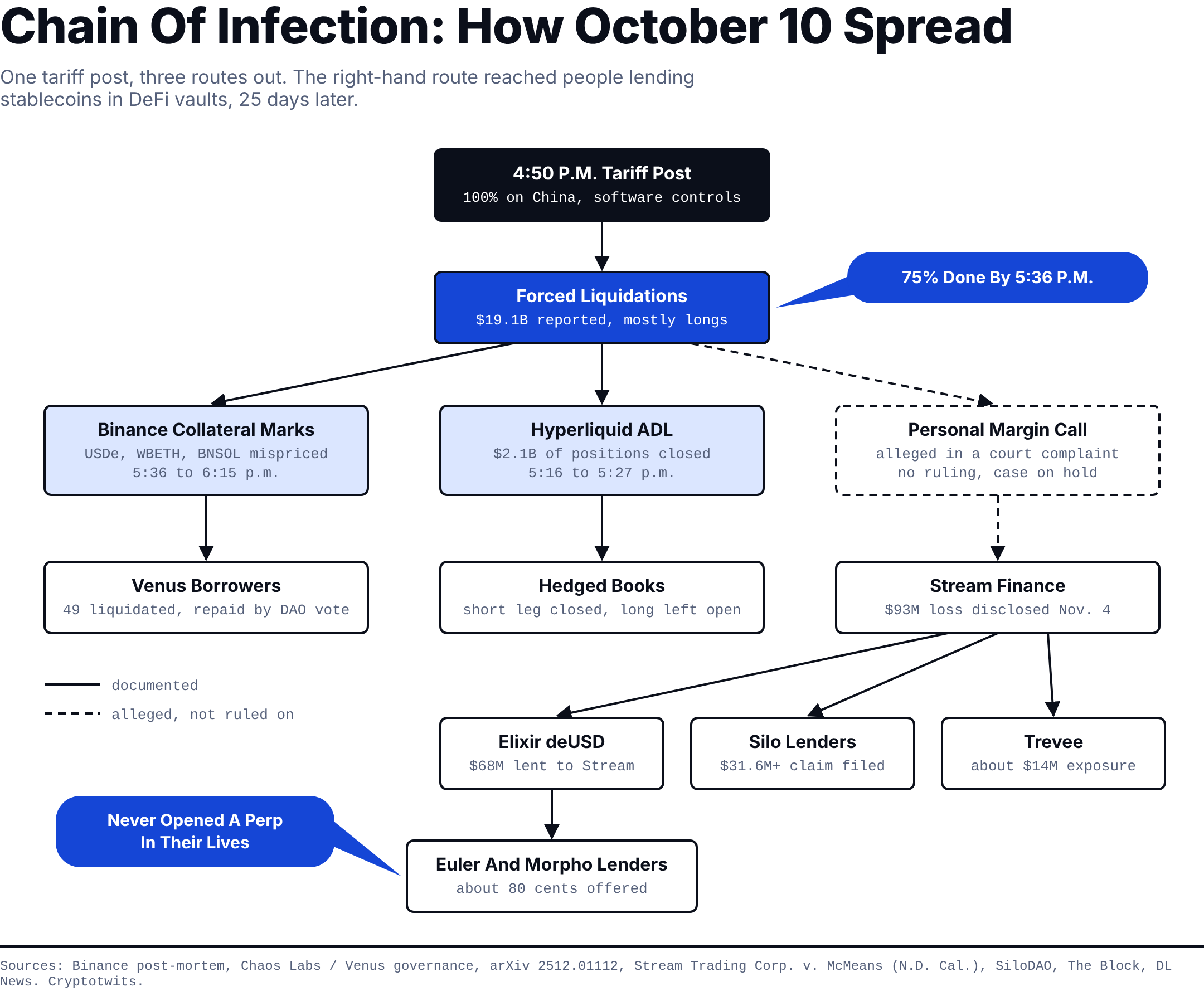
Click to enlarge.
OCTOBER 10 POST-MORTEM
Patient Zero Was A Post 📢
The host was not healthy going in. $BTC ( ▲ 0.53% ) had printed an all-time high near $126,200 four days earlier, and CoinGecko counted about $217 billion of perpetual futures open interest stacked on top of it, so the market had the immune system of a Victorian orphan. 🤒
First exposure came at 10:57 a.m., when President Trump posted that China's rare-earth letter was "very hostile" and that a big tariff increase was being calculated. Markets coughed. The S&P 500 closed down 2.7%, its sharpest drop since April (2025).
Then stocks shut for the weekend. At 4:50 p.m. the second post landed, with an additional 100% tariff on China starting November 1 and export controls on critical software. Crypto was the only ward still admitting.
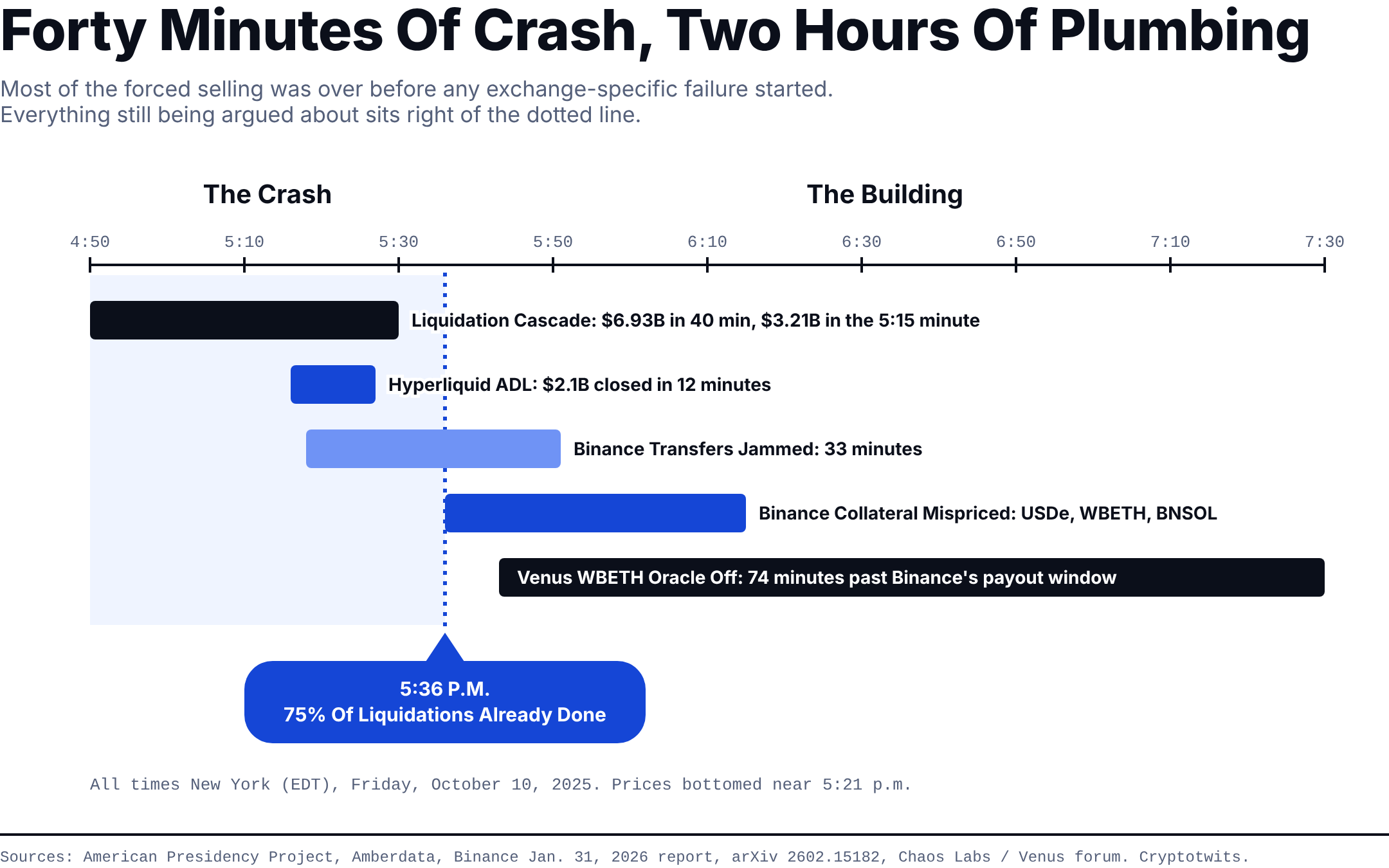
These were the 28 Days Later infected, not the shuffling kind. Amberdata counted $6.93 billion of forced closures in its dataset over the next 40 minutes, including a single minute at 5:15 p.m. worth $3.21 billion.
Bitcoin went from about $122,500 to under $105,000, and that was the mild case. $XRP ( ▲ 1.18% ), $DOGE ( ▲ 1.33% ) and $ADA ( ▲ 6.27% ) dropped 40% to 60% intraday before bouncing, and CoinGlass says many alts lost more than 80%.
Binance says prices hit their lows around 5:21 p.m. It also says three quarters of the day's liquidations were done before its own collateral prices broke at 5:36. Nearly everything people still fight about on Binance happened after that.
Click to enlarge.
PROMOTION
BitcoinIRA Has More Than Bitcoin. A Lot More.
BitcoinIRA gives you access to 100+ cryptocurrencies, one-click crypto bundles, and staking rewards on select assets - all inside a self-directed crypto IRA.

Buy, sell, and swap 100+ cryptocurrencies
Build diversified crypto bundles with automated rebalancing
Earn staking rewards on select assets inside your IRA*
Choose Traditional or Roth IRA options, with tax treatment depending on the account type*
*3rd Party Ad. Not an offer or recommendation by Stocktwits. See disclosure here.
OCTOBER 10 POST-MORTEM
Every Version Of The Body Count Is Wrong 💀
About $19 billion is the number on the chart at the foot of the bed. I even used that number, I still use that number, eveybody still uses that number. Why? It's the face value of the positions that got closed, which is a count of beds filled, and says nothing about who walked out. 🛏
It's also low. CoinGlass later put the figure(s) at $30 to $40 billion once you account for how some exchanges report liquidations.
Ask around and the numbers run from $70 billion of open interest gone in a couple of days to 1.2 trillion euros of market value gone by New Year's, depending on who's counting and what. Just look at the chart below. None of them should be added together, because it's one patient getting billed by every department he was wheeled past.
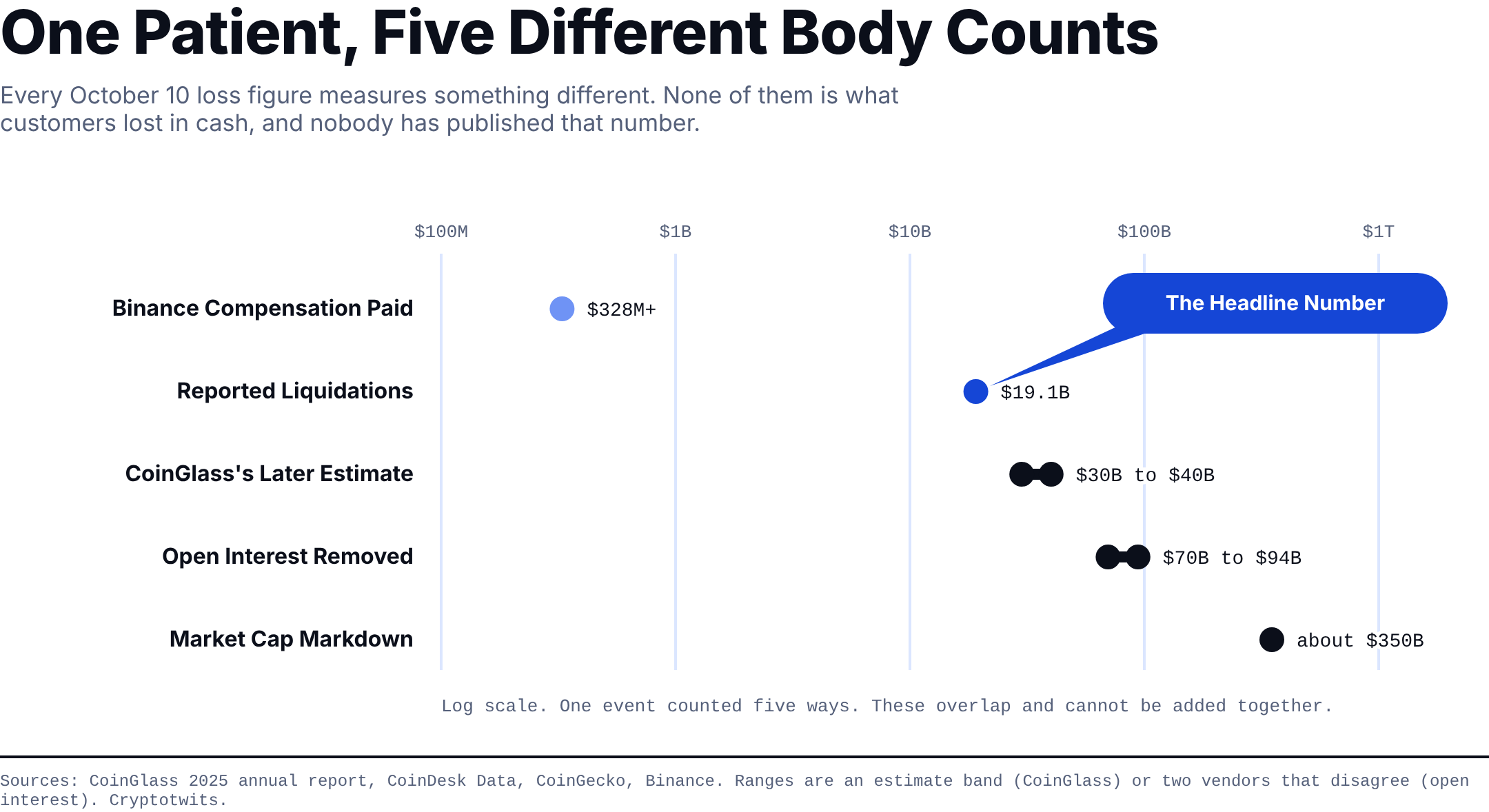
Click to enlarge.
What did customers lose, net, in cash? Nobody has published it. Hyperliquid is the largest venue where you could even try to work it out, because its fills are on-chain. ⛓
OCTOBER 10 POST-MORTEM
Transmission Route One: The Collateral 🧪
At 5:36 p.m. the first wave was mostly over. Then Binance's internal prices came unglued for three tokens people were posting as margin. $USDE ( ▼ 0.01% ) is $ENA ( ▲ 2.6% )’s synthetic dollar. WBETH and BNSOL are $BNB ( ▲ 1.3% )’s own wrapped versions of staked $ETH ( ▲ 0.92% ) and staked $SOL ( ▲ 0.31% ). 🏦
USDe printed around 66 cents on Binance while trading far closer to a dollar everywhere else. If USDe was your collateral, the exchange decided you were a third poorer than you'd been a minute ago and acted on it. That ran until about 6:16 p.m.
Topping up your account was not much of an option. From 5:18 to 5:51 p.m., transfers between Binance's spot, earn and futures wallets were jammed, and some users logged in to a balance of zero.
Binance had been paying a promotional 12% a year to hold USDe, and balances posted as collateral qualified. It was paying people to carry the exact thing it then marked down.
On October 6, four days before, Binance had announced a pricing change for WBETH and BNSOL, effective October 14. The vaccine was on the truck. That change didn't cover USDe.
Did this cause the crash? No. Three quarters of the liquidations were already done. This was the secondary infection, the kind that gets you after you survived the first thing. Like the second wave of the Spanish Flu - that was the super bad one.
Binance paid for it. More than $328 million had gone out by its January report, with a $300 million relief program and a $100 million loan facility pledged on top. The payouts were calculated against prices at 8 p.m., after the bounce.
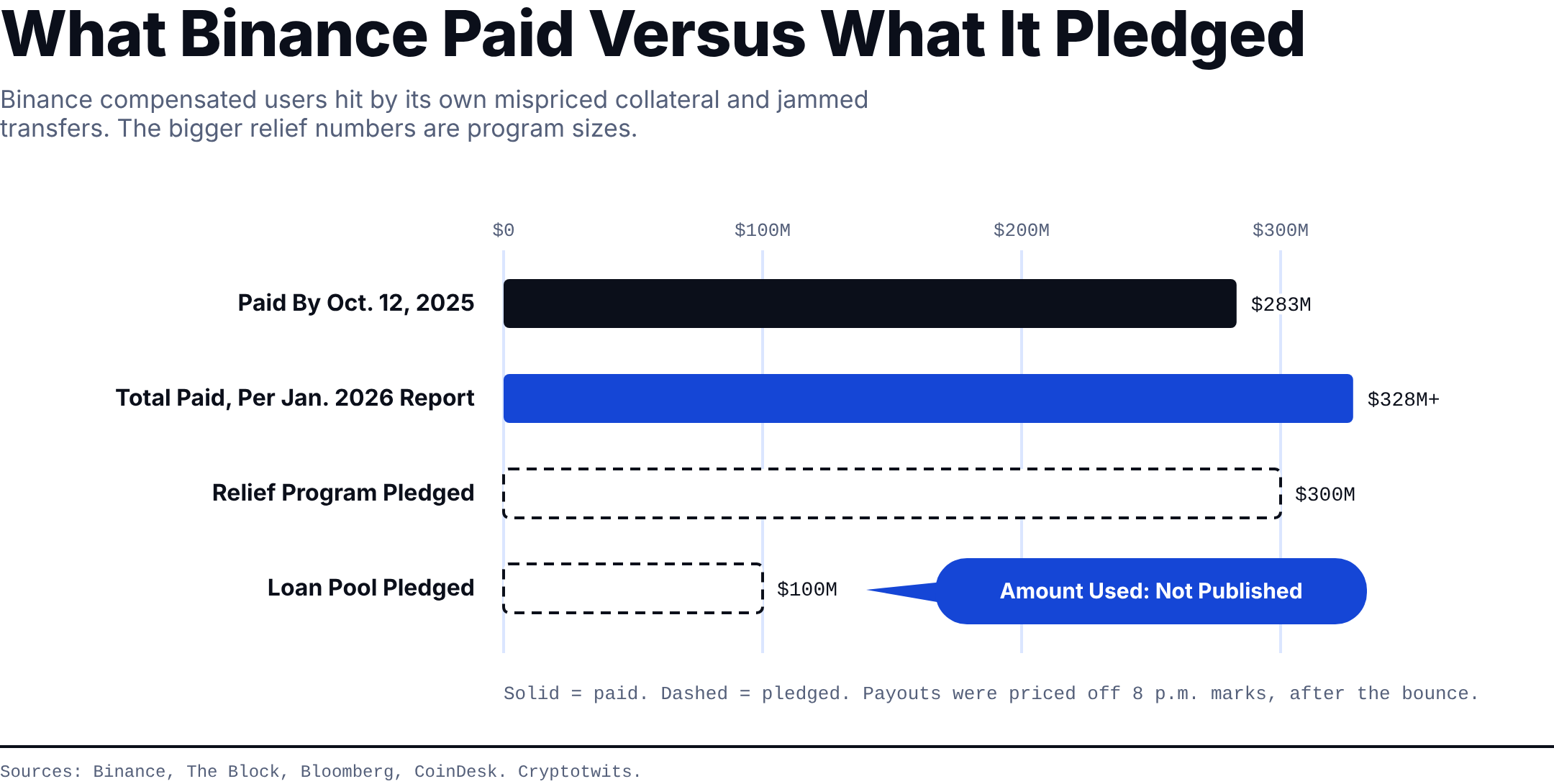
Click to enlarge.
Then it jumped buildings. Venus, a lending protocol on BNB Chain, was pricing WBETH off the same sick feed. Its oracle went wrong at 5:43 p.m. and didn't recover until about 7:30, more than an hour after Binance's compensation window had closed.
Forty-nine Venus borrowers were liquidated in that stretch because their WBETH collateral was marked down further than ether itself had fallen. Binance's program didn't cover them. Venus's DAO voted in late October to repay them out of its own risk fund. 💸
OCTOBER 10 POST-MORTEM
Transmission Route Two: The Cure 💉
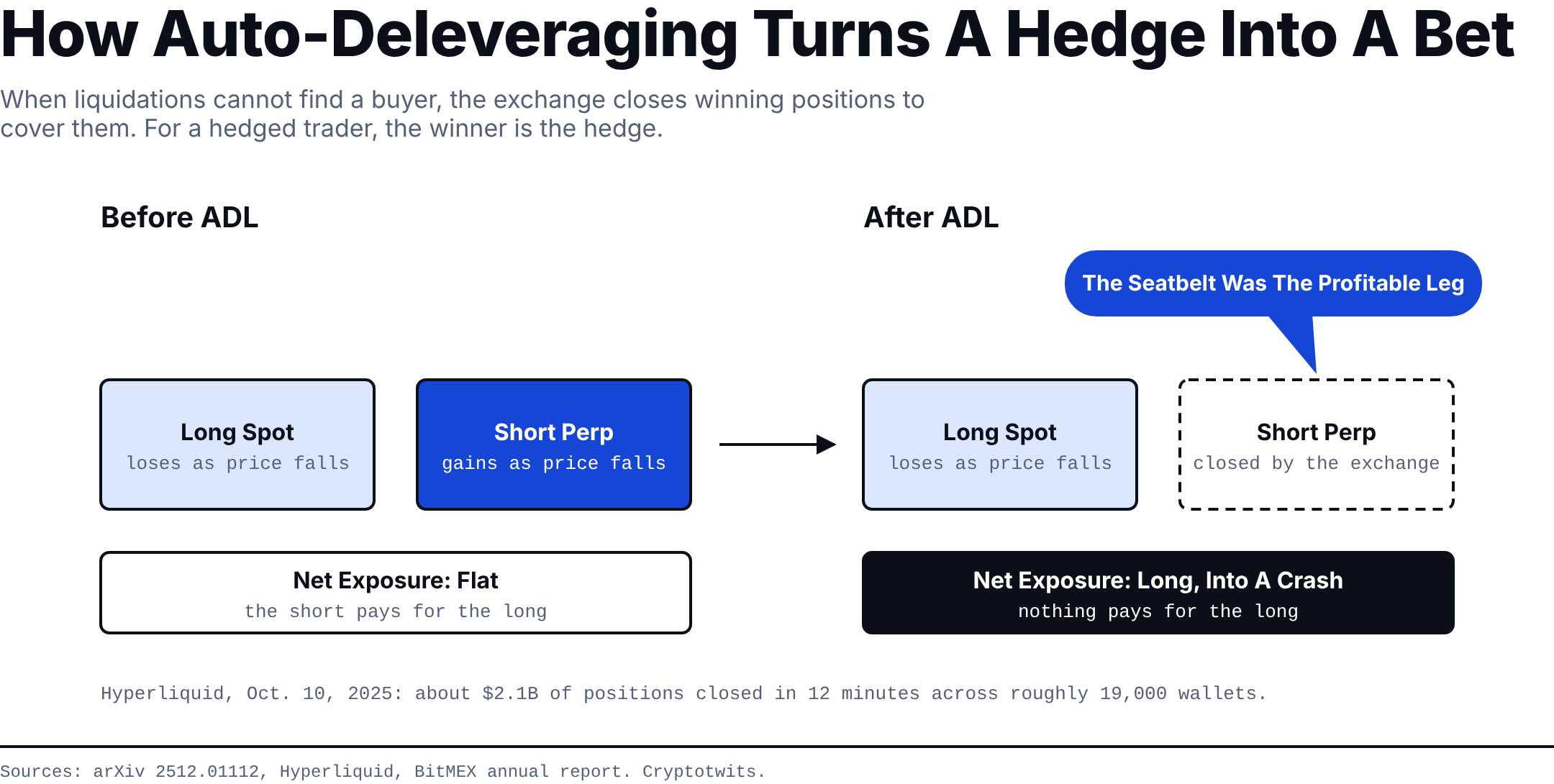
Auto-deleveraging is what an exchange does when liquidations can't find a buyer. It reaches into the winning accounts and closes them to cover the losing ones. I didn’t write that wrong and you read that right: you could be up on a winning position in a major short and think ‘omg lotter win’ but jokes on you because, well, the platform/exchange needs your winnings to save themselves. ⚖
On Hyperliquid it started at 5:16 p.m., twenty minutes before anything broke at Binance. About $2.1 billion of positions were closed in roughly 12 minutes across some 19,000 wallets, the first time in more than two years the venue had done it on cross-margin accounts.
By the exchange's scorecard it was clean. Hyperliquid reported no bad debt and no downtime.
The patients/users tell it differently. Say you ran a hedged book, long spot and short the perp. ADL closes the short because it's the leg making money. You are now just long, in the middle of that, and BitMEX's year-end report on perps says a lot of those orphaned longs got sold on the way down.
Click to enlarge.
So a liquidation screenshot doesn't tell you whether a trader was reckless. Some of these people showed up vaccinated and the hospital took it back.
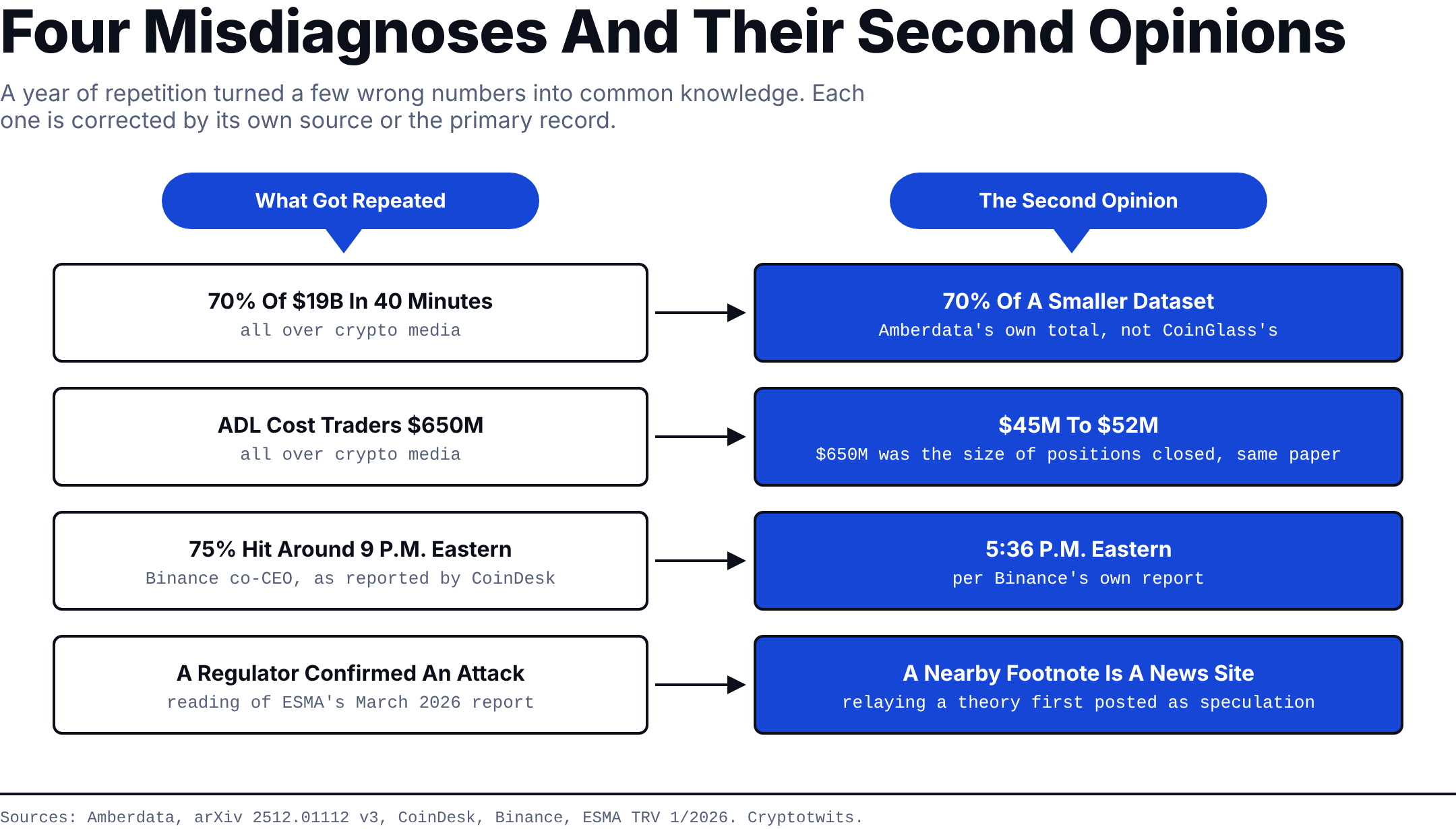
You may have seen ‘$650 million’ as the cost. That was the size of the positions closed. The same paper, by a super smart dood, Tarun Chitra, puts the excess profit taken from winning traders at $45 million to $52 million.
The big market makers were rumored dead by the next morning. Wintermute said it was fine, and three weeks later said it never planned to sue Binance, though its founder did call some of its own liquidation prices ridiculous. I haven't found a market maker that has confirmed a hole in public. 🕳
OCTOBER 10 POST-MORTEM
The Slow Strain ⏳
Some infections take weeks to show. This one took about three and a half. 🐌
On November 4, a DeFi yield outfit called Stream Finance disclosed that an external fund manager had lost about $93 million of its assets. Deposits and withdrawals froze, and its dollar token, xUSD, fell apart.
Analysts at YieldsAndMore mapped about $285 million of loans across DeFi backed by Stream's tokens. A stablecoin project called $ELIX ( ▲ 0.17% ) said it had lent Stream $68 million and that Stream held roughly 90% of Elixir's own dollar token, deUSD. Elixir retired deUSD two days later, after it had fallen to pennies.
The next ring out was people lending on $EUL ( ▲ 1.43% ) and $MORPHO ( ▲ 1.04% ) through professionally ‘curated’ vaults that had accepted those tokens. Past them were lenders on Silo, whose DAO filed a claim for more than $31.6 million in stablecoins plus roughly 273 wrapped BTC, and on Trevee, which had about $14 million of exposure.
These were mostly people who parked stablecoins in a vault for yield and never touched a perp. It was the blood test from The Thing.
Where did Stream's hole come from? 🤔
On December 8, Stream Trading Corp. sued Caleb McMeans, the trader it says took over running the protocol in January 2025, in federal court in San Francisco. The complaint alleges that a trader named Ryan DeMattia faced a margin call on a personal loan on October 10, could not meet it, and that Stream assets were then used to cover the loss. The same complaint concedes that ‘the precise facts underlying this loss remain unclear.’
The case was put on hold on May 13 (2026), two days after Stream announced it was winding down. A year later, nobody outside that company has shown where the money went.
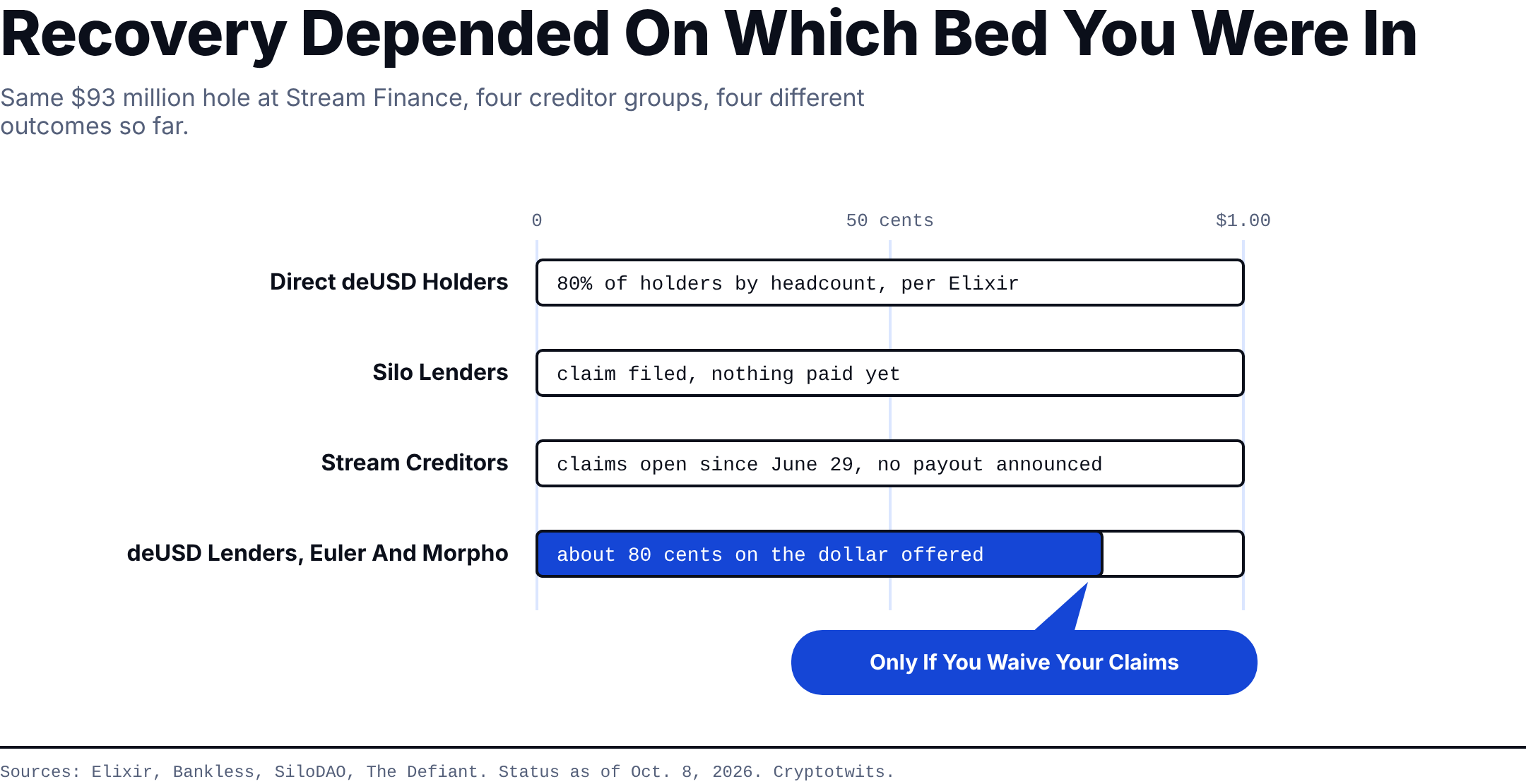
Recovery depended on which bed you were in. Elixir says it redeemed 80% of deUSD holders, which is a headcount, and by dollars most of the supply sat with Stream. Lenders against deUSD on Euler and Morpho were offered about 80 cents on the dollar, provided they waive claims against Elixir, Euler, certain curators and others. Silo's DAO filed for everyone, then in August told lenders to file their own claims too.
Click to enlarge.
Stream started collecting creditor claims on June 29. I couldn’t find a payout announcement. 📭
OCTOBER 10 POST-MORTEM
The Immune 🛡️
Every outbreak has people who walk through the ward and don't get so much as a sniffle. Like my wife. During COVID, she was the only one in the house who ever met anyone in person and me and the kids got COVID and she caught zip, zero, zilch. Anyway… 🤧
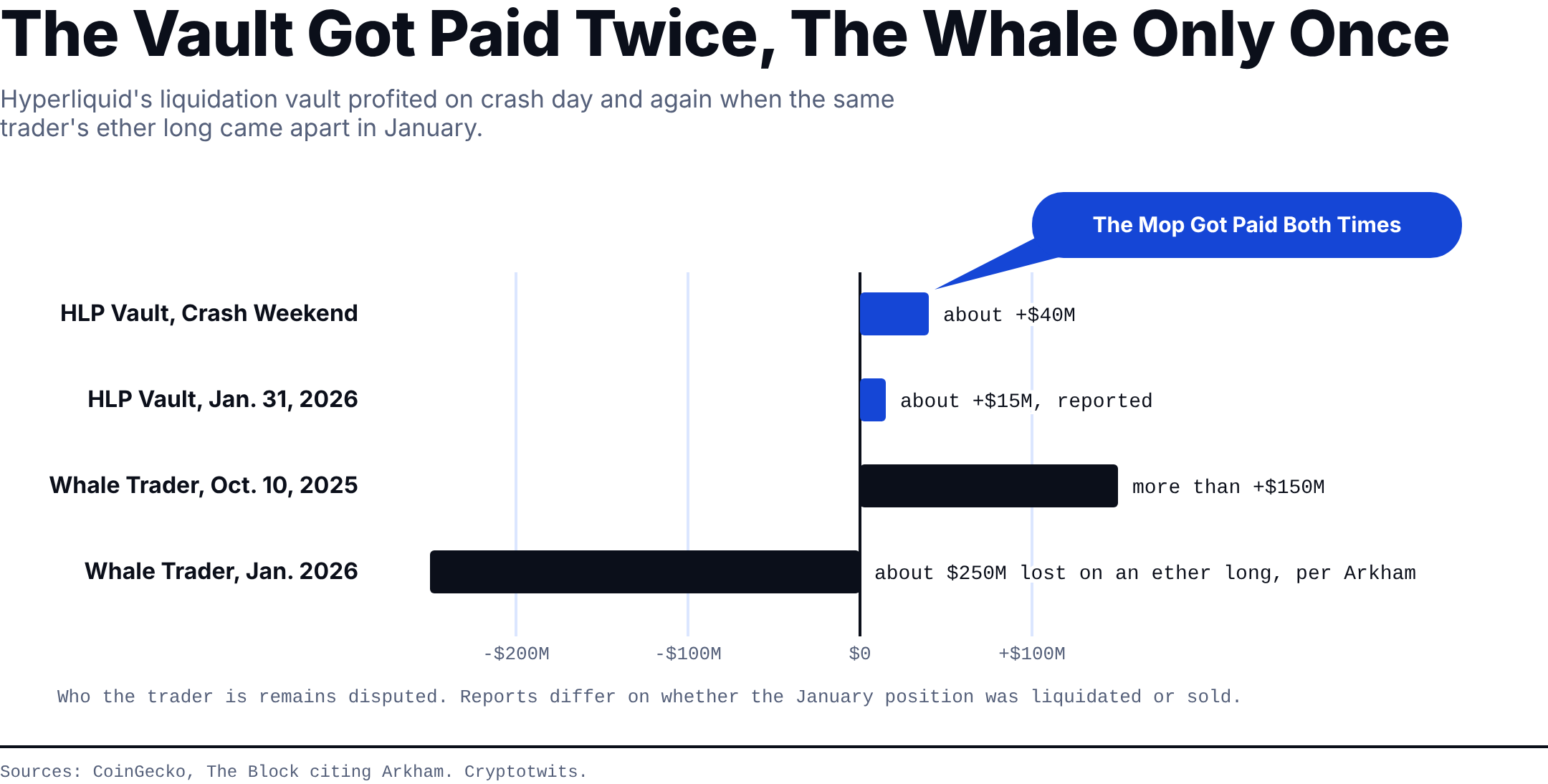
$HYPE ( ▲ 0.94% )’s HLP vault, the pool that takes over liquidated positions, made about $40 million over the crash weekend, a gain of roughly 10% for standing there with a mop.
Then there's ‘the whale’. A Hyperliquid trader reportedly built large BTC and ETH shorts in the run-up to the 4:50 post, adding to them until about a minute before it, and cleared more than $150 million. The internet's theory was inside information. Sleuths tied the wallet to Garrett Jin, a former exchange CEO. Jin says the money belongs to clients, that it wasn't insider trading, and that he has no link to the Trump family. The amazing on-chain investigator, ZachXBT, said the trader looked more like a friend of Jin's.
Good timing isn't evidence. Jin denies it and nobody has shown otherwise.
It didn't last. By January 31 the same trader had exited an ETH long that was worth more than $700 million at its peak, for a loss Arkham put near $250 million. Reports differ on whether the position was liquidated or sold. HLP reportedly made about $15 million on it. 🧹
Click to enlarge.
OCTOBER 10 POST-MORTEM
Misdiagnoses 🩺
A year of people playing doctor left some charts that need correcting. 📋
Click to enlarge.
A fact/claim that a lot of us remember hearing is that 70% of the $19 billion happened in 40 minutes. It was 70% of Amberdata's own, smaller dataset, which is a different patient list.
Then there's the regulator that supposedly confirmed Binance was attacked. Europe's markets watchdog, ESMA, wrote in March that attackers "seemingly exploited" Binance's pricing.
In February, CoinDesk reported Binance's co-CEO telling a Hong Kong conference that three quarters of the liquidations came around 9 p.m. Eastern. Binance's own report puts that point at 5:36 p.m. Eastern, which is 21:36 on a UTC clock. I’m just guessing/assuming that someone saw 21:36 and thought 9PM. But taken at face value it puts the bulk of the liquidations about three and a half hours after the depeg began, the opposite of what Binance's report argues.
Also, the USDe depeg did not start it. Binance has prices bottoming around 5:21 and the depeg beginning at 5:36. One of Ethena's louder defenders puts that gap at about 30 minutes. By Binance's timestamps it was closer to 15. ⏱
OCTOBER 10 POST-MORTEM
One Year Later 🌡️
The fever broke but there are still some symptoms. 💊
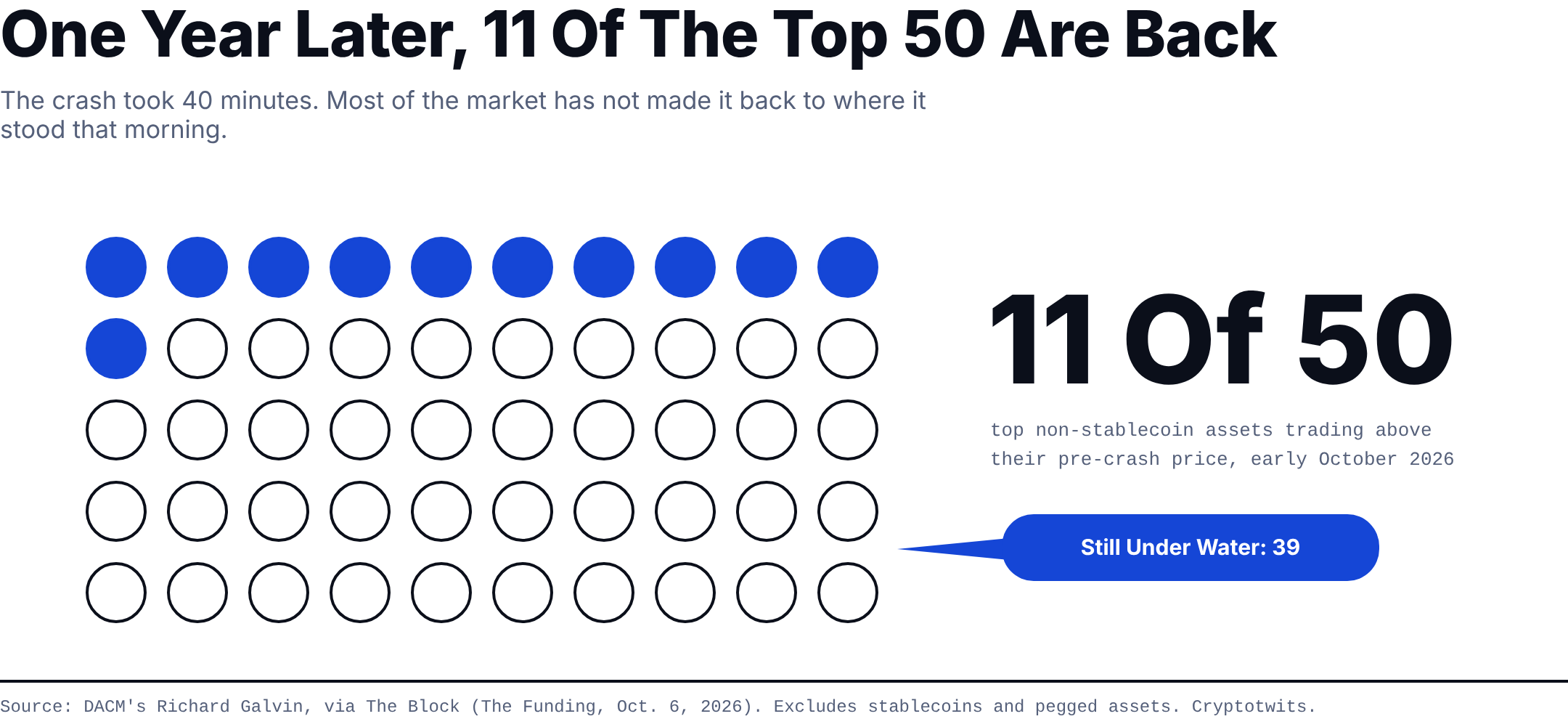
One fund manager, DACM's Richard Galvin, told The Block this month that only 11 of the top 50 assets, leaving out stablecoins and pegged tokens, trade above where they were before the crash, and that July volumes ran 60% to 70% below pre-crash levels. A research shop that tracks crypto funds says a number of small managers, mostly under $2 million, have closed.
Click to enlarge.
I can't pin all of that on October 10. A market can have more than one thing wrong with it.
The tracing still comes up empty in places. Nobody has published what customers lost in net dollars. Only Binance knows how much USDe was sitting in its margin accounts at 5:30 p.m., how many compensation claims it turned down, or how much of the relief money got used. The one lawsuit I found that touched Stream's $93 million is a contract claim, and it's on hold. The market-maker rumors have produced no confirmations.
The official cause of death is still macro shock, and for the first half hour that's fair. After that the hospital did its share of the damage, through how it priced collateral and who it chose to close first.
Stream's creditors are still waiting on a first payment. We might have to wait another year until more information comes out.⌛
Get In Touch 📬
Email me, Jonathan Morgan, feedback; I’d love to hear from you. 📧
Follow me on Stocktwits 🫂 And Sponsor this newsletter 😎
|
Get the app Real-time alerts, live earnings calls, your personalised feed - the best experience is on mobile.
|


Terms & Conditions 📝
Securities Disclaimer: STOCKTWITS IS NOT A TAX ADVISOR, BROKER, FINANCIAL ADVISOR OR INVESTMENT ADVISOR. THE SERVICE IS NOT INTENDED TO PROVIDE TAX, LEGAL, FINANCIAL OR INVESTMENT ADVICE, AND NOTHING ON THE SERVICE SHOULD BE CONSTRUED AS AN OFFER TO SELL, A SOLICITATION OF AN OFFER TO BUY, OR A RECOMMENDATION FOR ANY SECURITY. Trading in such securities can result in immediate and substantial losses of the capital invested. You should only invest risk capital, and not capital required for other purposes. You alone are solely responsible for determining whether any investment, security or strategy, or any other product or service, is appropriate or suitable for you based on your investment objectives and personal and financial situation. You should also consult an attorney or tax professional regarding your specific legal or tax situation. The Content is to be used for informational and entertainment purposes only and the Service does not provide investment advice for any individual. Stocktwits, its affiliates and partners specifically disclaim any and all liability or loss arising out of any action taken in reliance on Content, including but not limited to market value or other loss on the sale or purchase of any company, property, product, service, security, instrument, or any other matter. You understand that an investment in any security is subject to a number of risks, and that discussions of any security published on the Service will not contain a list or description of relevant risk factors. In addition, please note that some of the stocks about which Content is published on the Service have a low market capitalization and/or insufficient public float. Such stocks are subject to more risk than stocks of larger companies, including greater volatility, lower liquidity and less publicly available information. Read the full terms & conditions here. 🔍
Author Disclosure: The author of this newsletter holds positions in AVAX, ADA, PUDGY, WLD, NEAR, INJ, LTC, LINK, ZEC, XLM, and FET. 📋