OVERVIEW
Market Reminds Everyone It Loves Them Just Enough To Keep Hurting Them ❤

Here’s What’s Happening 👇
Today’s top trending tickers: $SHIB ( ▲ 9.27% ), $MASK ( ▲ 1.23% ), $ALGO ( ▲ 2.0% ), $BNB ( ▲ 1.45% ), and $BCH ( ▲ 4.25% )
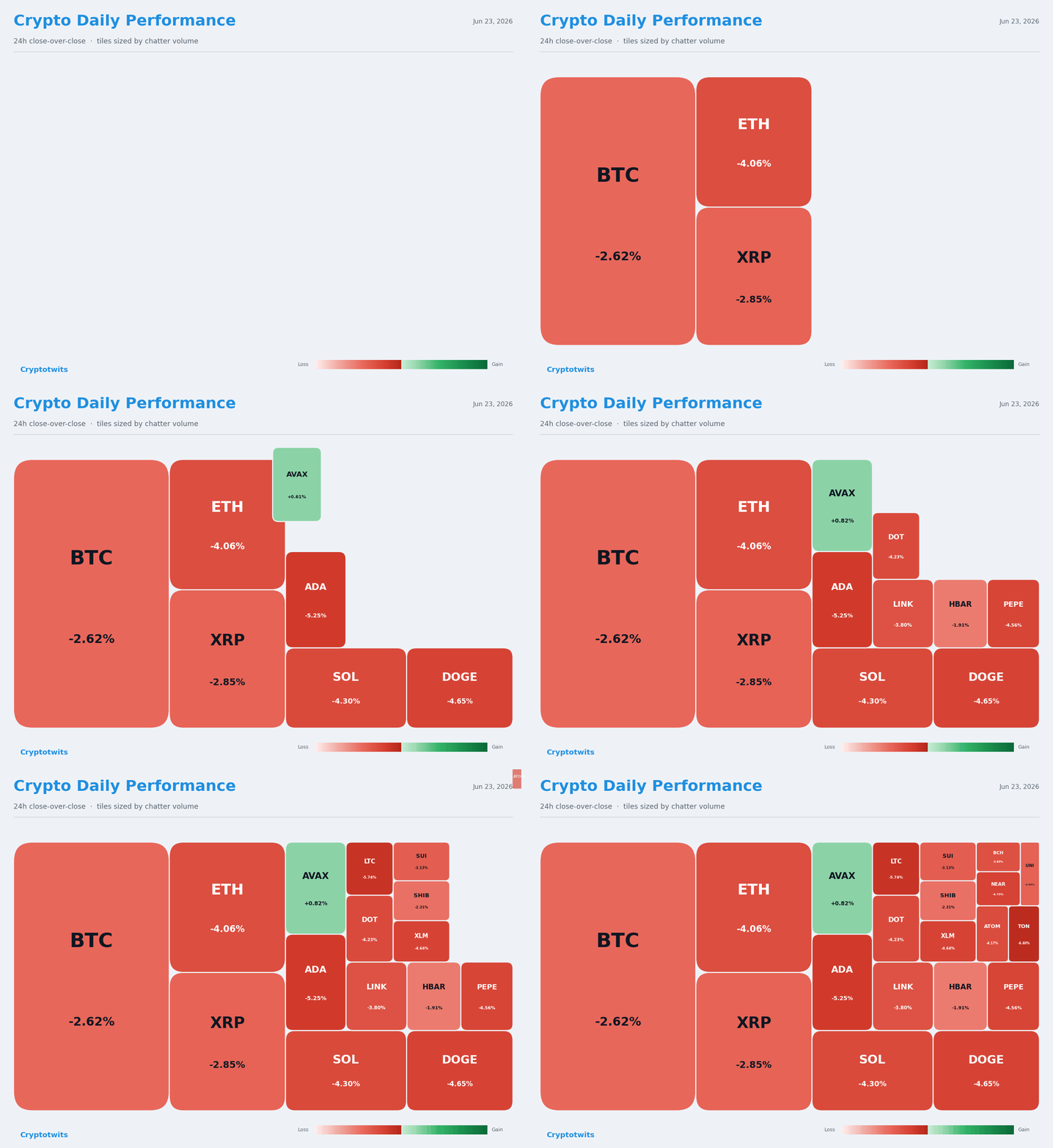
Click to enlarge.
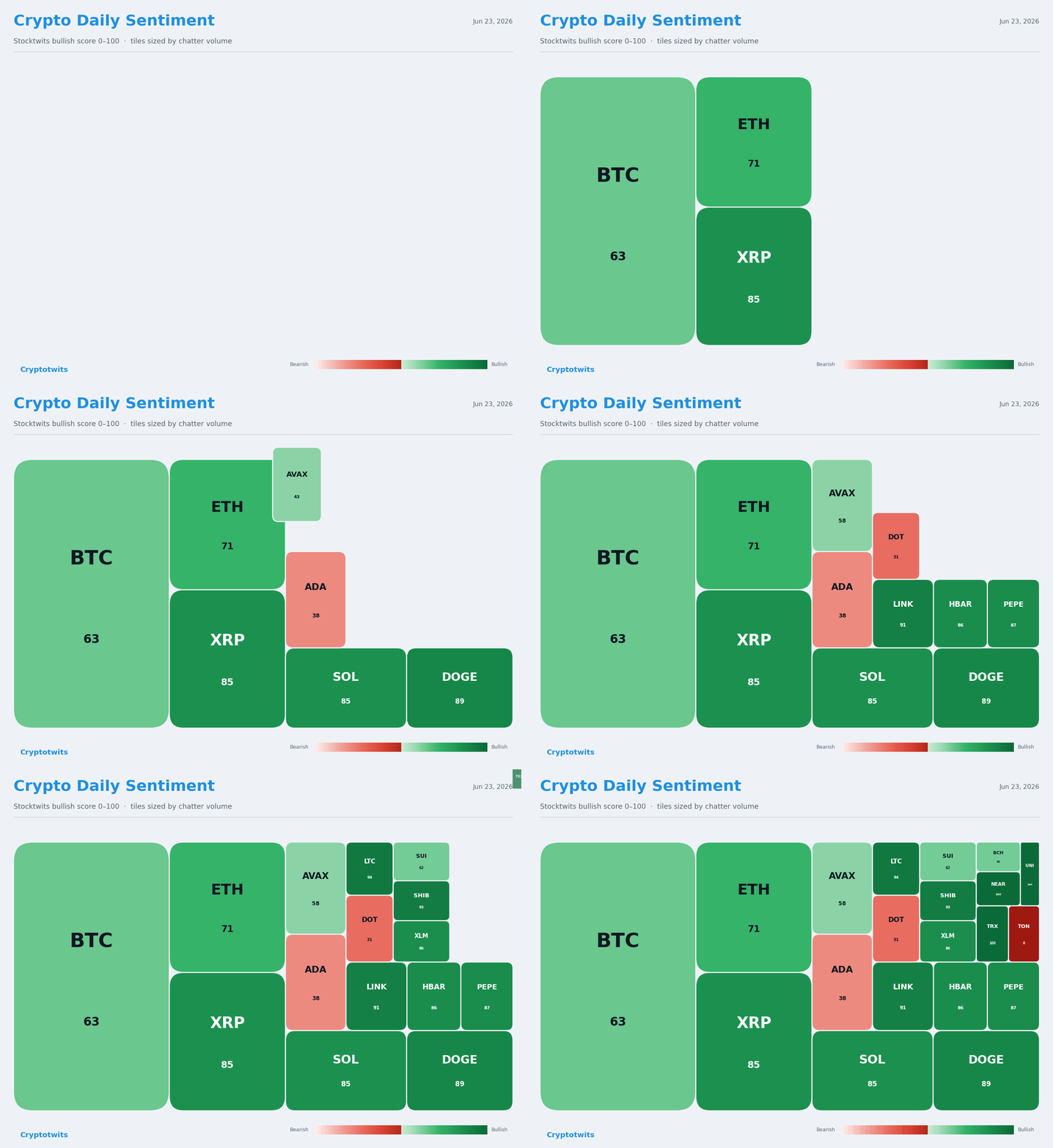
Click to enlarge.
NEWS
The Ethereum Foundation's Long, Bad Year 😢
Has your year been bad? Probably hasn’t been Ethereum Foundation bad. They’ve spent the first half of 2026 shedding people and dodging questions about money. And today’s most recent post from them is just another example of how rough of a year they’re having:
The EF is cutting 54 jobs, about 20% of its staff, and folding what remains into five clusters tied to its new Mandate and Treasury Management Policy. $ETH ( ▲ 2.41% ) tanked roughly 7% on the headline. Or maybe it was just because everything else is red and dead. Either way, this didn’t help it.
Lots & Lots Of Drama
Last week, co-executive director Hsiao-Wei Wang stepped down after a sabbatical, effective immediately.
She had been there for nearly everything major that Ethereum has done: joined the research team in 2017 and worked on the Beacon Chain, the Merge, Shapella and Dencun. Her exit was the second co-ED departure in four months, following Tomasz Stańczak in February, and that left board member Bastian Aue running the place alone.
With her now gone, that’s around 19 departures this year: Josh Stark and Trent Van Epps in April, five senior researchers in May, protocol leads Tim Beiko and Barnabe Monnot, and the Privacy and Scaling Explorations group wound down as a standalone team.
But it’s not like they’ve all just left Ethereum.
Yesterday, five of the departed researchers launched Ethlabs, an independent (you’ll read why I put that in italics here in a second) nonprofit built to ready Ethereum for institutional money. The backers are the parties with the most ETH to protect: $BMNR ( ▲ 8.7% ) and $SBET ( ▲ 6.74% ) the two largest corporate holders, plus Joe Lubin (ETH co-founder), Anchorage, Octant and SNZ.
So, basically, the whales just funded a parallel lab for the people who did the work.
NEWS
First UK-Regulated Onchain Fund Arrives Fashionably Late 👗
Baillie Gifford just came out with the UK’s first publicly available and native UK-registered tokenized bond fund. They called it BAGEY. Edinburger manager BNY is the custodian and it’s live on $SOL ( ▲ 4.78% ) and $ETH ( ▲ 2.41% ). Their goal is 7% through active fixed-income management.
If it sounds familiar, it should. Both Franklin Templeton and Black Rock have money funds on-chain. Also, TradFi hasn’t stopped building and accumulating in the space: Franklin Templeton bought 250 Digital just this month, $C ( ▲ 2.49% ) is tokenizing private shares, and $ICE ( ▼ 0.06% ) and OKX are doing their thing, too.
It’s FCA-approved (Brits’ version of the SEC). Oh, the funny part about all of this: subscriptions and redemptions clear in $USDC ( ▲ 0.0% ). In the UK.
NEWS
The Finish Line Is Visible. The Senate Floor Is Not. 😰
The House Financial Services Committee published its July calendar, and among the routine oversight sits a July 17 field hearing in New York titled "How the CLARITY Act Unlocks Innovation."
Now, don’t get excited, because the field hearing is mostly a fluff piece of a meeting and get together. The Senate is the hold up, it’s where the bill is parked still.
However, there is one part that Senator Cynthia Lummis called attention to today:
And depending on how deep into crypto principles you are, what she wrote may or may not be something you skip on your feed. But it’s a big deal, because the alternative to what she wrote is prison.
Operating an unlicensed money transmitting business is a federal felony under 18 U.S.C. § 1960, and for years the open question was whether publishing non-custodial code counts. In other words, can written code be considered a crime?
The DOJ ran exactly that theory against the Tornado Cash and Samourai Wallet developers, charging people who never held a user's coins. A current DOJ memo says do not stretch § 1960 to code and coders, but a memo reverses with a signature and an election.
So the House is celebrating how the bill works before the Senate has voted on whether it becomes law. Cut the ribbon when the building has a roof.
TECHNICAL ANALYSIS
False Reprieve vs. Acceptance Onset: Putting a Gauge on Market Mourning 🕵
Here’s your daily dose of odd but cool:
In 1962 a market technician named Edwin Coppock got a request from the Episcopal Church. The church had long-term money to invest and wanted to know when to put it to work after a market had been beaten down. Coppock reasoned that a market climbing out of a bear behaves like a person climbing out of mourning.
So he did the obvious thing for a man in 1962 holding a question about grief. He asked the clergy how long it lasts. They told him eleven to fourteen months.

Coppock Curve, Total Crypto Market Cap Weekly Chart - Click to enlarge.
Those two numbers are the entire foundation of the Coppock Curve. It’s a ten-month weighted average of the sum of a fourteen-month and an eleven-month rate of change (ROC). The idea is that when the curve turns up from below zero, long opportunities are created. That is the whole indicator.
Price is a record of how a crowd feels. Coppock just had the balls in 1960 to ask about feelings and then make it into something that could help make money.
What Grief Research Says
You’ll be shocked to know that the field of mental health and, specifically, the study of grief has advanced beyond the Episcopal clergy of 1960.
Modern bereavement science has measured the time course of grief directly. There is a loooooong study (I cheated here, my wife is a Psychologist so she pointed me in the right direction, which is also the first time I purposely went in that direction), The Yale Bereavement Study, which tracked bereaved adults month by month instead of assuming a tidy this-then-that of stages.
It found the famous five stages were never a real sequence at all. Disbelief is highest right after the loss and falls from there. Yearning peaks around four months. Anger peaks around five. Depression peaks around six. Acceptance climbs the whole way through.
So the deepest part of grief, the trough where a person is most severed from their old life, sits at roughly four to six months. The clergy's eleven-to-fourteen-month answer is not the bottom of the well but the point where most people have already climbed out.
The Acute Grief Curve

Acute Grief Curve, Total Crypto Market Cap Weekly Chart - Click to enlarge.
The whole time cycle for bear market crashes compresses into months instead of years, and crypto runs the cycle on fast-forward. So the acute phase, months four through six, is the part that maps onto a crypto bottom, and the slow integration window Coppock used is far too sluggish to catch one. So I updated it.
How The Acute Grief Curve Is Built
The time periods. The Acute Grief Curve is a five-month weighted average of the sum of a six-month and a four-month rate of change. The six is the depression peak. The four is the yearning peak. Those are the two deepest points of acute grief, and the five-month smoothing is roughly the width of the acute window itself.
Log price. Instead of raw percentage change I compute the rate of change on the logarithm of price. This is the move that lets the indicator survive on crypto.
The reprieve filter - this the one I think most important. It comes straight out of the Dual Process Model of grieving, from Margaret Stroebe and Henk Schut. Their insight is that healthy recovery is not a straight line. You oscillate between confronting the loss and getting on with life, and the sign that you are recovering is not that the pain stops. It is that the swings get smaller. The oscillations damp.
That translates cleanly to price, because volatility is the market's emotional amplitude. When the curve turns up from below zero while volatility is contracting, the swings are damping, the grief is integrating, and the signal is real. That is Acceptance Onset (green triangles). When the curve turns up while volatility is still expanding, you get a False Reprieve instead (orange-ish dots).
I’ve made the indicator open-source and available on TradingView, here.
OLD NEWS
Crypto Stuff That Happened Today, But A Long Time Ago 📜
Here’s what was happening in the newsletter a year ago today:
I almost got nailed by a fake Coinbase support scam - robocall, follow-up “Mike from Coinbase,” sketchy email, whole bit. Exchanges don’t call you, and unsolicited reset stuff is bait.
The market damage was mostly in alts - the piece basically turned into an altcoin obituary column, with a pile of names hitting fresh all-time lows, multi-year lows, or ugly losing streaks.
Stablecoin regulation kept moving - the GENIUS Act and other global stablecoin rules were framed as the next big infrastructure shift, while Alchemy Pay decided to launch its own chain anyway.
OLD NEWS
Other Stuff That Happened Today, But A Long Ass Time Ago ⌛
June 23
1314 - The Battle of Bannockburn began, with Robert the Bruce’s Scots setting up a massive win over England and a long shelf life for national pride. And move. Well, several movies.
1789 - Louis XVI rejected the Third Estate’s National Assembly claim.
1868 - The first practical typewriter patent was granted.
1888 - Frederick Douglass received a presidential nomination vote, becoming the first Black candidate placed in nomination for U.S. president at a major party convention.
1894 - The International Olympic Committee was founded.
1956 - Gamal Abdel Nasser was elected Egypt’s president.
1961 - The Antarctic Treaty entered into force.
1972 - Nixon signed Title IX into law, banning sex discrimination in federally funded education and changing schools and sports in a massive way.
2016 - Britain voted for Brexit, choosing to leave the EU by 51.9% to 48.1% and detonating a political mess with excellent staying power.
2018 - The Thai Wild Boars soccer team became trapped in a flooded cave, starting one of the most terrifying rescue sagas in recent memory. No, it is the craziest rescue story in recent memory.
2023 - Wagner launched its rebellion in Russia, with Prigozhin’s mercenaries beginning the armed mutiny that briefly made Moscow wonder how close “civil war” was on the menu.
Get In Touch 📬
Email me, Jonathan Morgan, feedback; I’d love to hear from you. 📧
Follow me on Stocktwits 🫂 And Sponsor this newsletter 😎
How Was Cryptotwits Today?
Terms & Conditions 📝
Securities Disclaimer: STOCKTWITS IS NOT A TAX ADVISOR, BROKER, FINANCIAL ADVISOR OR INVESTMENT ADVISOR. THE SERVICE IS NOT INTENDED TO PROVIDE TAX, LEGAL, FINANCIAL OR INVESTMENT ADVICE, AND NOTHING ON THE SERVICE SHOULD BE CONSTRUED AS AN OFFER TO SELL, A SOLICITATION OF AN OFFER TO BUY, OR A RECOMMENDATION FOR ANY SECURITY. Trading in such securities can result in immediate and substantial losses of the capital invested. You should only invest risk capital, and not capital required for other purposes. You alone are solely responsible for determining whether any investment, security or strategy, or any other product or service, is appropriate or suitable for you based on your investment objectives and personal and financial situation. You should also consult an attorney or tax professional regarding your specific legal or tax situation. The Content is to be used for informational and entertainment purposes only and the Service does not provide investment advice for any individual. Stocktwits, its affiliates and partners specifically disclaim any and all liability or loss arising out of any action taken in reliance on Content, including but not limited to market value or other loss on the sale or purchase of any company, property, product, service, security, instrument, or any other matter. You understand that an investment in any security is subject to a number of risks, and that discussions of any security published on the Service will not contain a list or description of relevant risk factors. In addition, please note that some of the stocks about which Content is published on the Service have a low market capitalization and/or insufficient public float. Such stocks are subject to more risk than stocks of larger companies, including greater volatility, lower liquidity and less publicly available information. Read the full terms & conditions here. 🔍
Author Disclosure: The author of this newsletter holds positions in AVAX, ADA, PUDGY, WLD, NEAR, INJ, LTC, LINK, ZEC, XLM, and FET. 📋